What if I Was a Stone
Speculative Worlding through a Nonhuman Avatar
Abstract / Text
<strong>Abstract</strong>
What if I Was a Stone? is a VR performance that asks what changes when a person enters a virtual world through the body of a stone. During the performance, a tracked body lies still while breathing and small movements animate a digital stone in an empty desert. The work explores a cyborg relation in which the body is translated through the technical system and becomes visible as the stone. When control gives way to stillness or sleep, presence remains, but it is no longer located in the human body alone.
<strong>Project text</strong>
What if I Was a Stone? began with a speculative question: what might change when virtual embodiment is approached from the position of a stone? Dunne and Raby describe speculative scenarios as “often starting with a what-if question.” Their fictional nature allows people to “momentarily forget how things are now” and “wonder about how things could be” (2013, p. 3). The title proposes an impossible shift in perspective. The performance uses digital design to examine what happens when human presence is translated through a nonhuman form.
For the performance, I designed a stone avatar and placed it in an empty virtual desert. I wore a VR headset and lay motionless on the ground. Tracking transferred my physical movement to the digital body, but very little of it remained visible. The stone offered almost no recognisably human means of expression. It had no face and could not be read as a human body. The desert forms part of the speculative setup. Because the environment is almost empty, the stone becomes the main point of attention. Dunne and Raby describe fictional worlds as constructions used “for reflection, critique, provocation, and inspiration” and identify game design as a field concerned with “literal world creation” (2013, p. 70). The virtual desert therefore creates the conditions through which the stone can be perceived as a body.
The stone avatar cannot be separated from the desert, the tracking system, or my body. The desert makes the stone appear isolated and still, while tracking allows me to experience that stillness physically. Haraway’s cyborg offers a way to understand this relation because it unsettles any clear separation between organism and machine. She defines the cyborg as “a hybrid of machine and organism” (2016a, p. 5) and later writes that “the machine is us, our processes, an aspect of our embodiment” (2016a, p. 65). During the performance, I do not begin as a complete human subject who then uses the stone as a tool. The headset registers my body, the software translates its movement, and the stone gives that translation a visible form. Haraway writes of companion species that “we make each other up, in the flesh” (2016a, p. 94). In the performance, my body gives the stone presence, while the stone changes how I experience my own body. The performance takes shape through this mutual formation.
From the outside, the performance could be described as a person controlling a digital stone. This keeps a clear hierarchy between the human and the avatar, as though I remain unchanged behind the representation. During the performance, however, the stone’s body changes how I inhabit my own. Haraway writes that in the relation between human and machine, “it is not clear who makes and who is made” (2016a, p. 60). The stone is therefore not simply an image I control. It takes part in shaping how my body becomes present within the virtual world. When I say that I become the stone, I mean that I enter a temporary technical relation with it. I am not claiming to access the consciousness of a rock or to speak on its behalf. The performance tries to remain partly inaccessible. It does not reveal a personality or respond to the observer. The stone remains somewhere between an avatar, an object, and part of the landscape. My own position within it is never completely clear.
Haraway identifies “active/passive” as one of the dualisms through which Western thought separates the acting subject from the object acted upon (2016a, p. 59). The stone is usually placed on the passive side of this division. It is treated as matter without intention, waiting to be used. The performance examines what passivity might mean beyond simple absence. Even when I lie still, my body continues to produce tracking data and the software continues to translate it.
During some performances, I fell asleep while wearing the headset. I began to think of this as the stone’s sleep. Sleep makes the sympoietic structure of the performance especially clear because I am no longer consciously directing what happens. I cannot decide how my body moves or how it appears through the avatar. Still, my breathing and small involuntary movements remain available to the tracking system and continue to be translated by the software. My body stays involved, but in a vulnerable position. I give up deliberate control while the headset, trackers, and software continue to register and act through me. Haraway uses the term sympoiesis to describe processes of “making-with,” in which nothing produces itself in isolation (2016b, p. 58). The sleeping body does not animate the stone alone, and the technical system does not produce it alone. The stone continues through the relation between them.
The relationship changes what each participant becomes. Neither the subject nor the object exists as fully formed before the encounter (Haraway, 2016b, p. 13). A temporary relation develops between my body and the digital stone. I remain present, but no longer through the image of a complete human individual. The stone does not reproduce geological time, yet its stillness makes the limits of human attention more noticeable. What if I Was a Stone? leaves the transformation incomplete. The performance creates a temporary relation in which the body approaches the stone without fully becoming it.
<strong>References</strong>
Dunne, A., & Raby, F. (2013). Speculative everything: Design, fiction, and social dreaming. MIT Press.
Haraway, D. J. (2016a). A cyborg manifesto: Science, technology, and socialist-feminism in the late twentieth century. In Manifestly Haraway. University of Minnesota Press. (Original work published 1985)
Haraway, D. J. (2016b). Staying with the trouble: Making kin in the Chthulucene. Duke University Press.
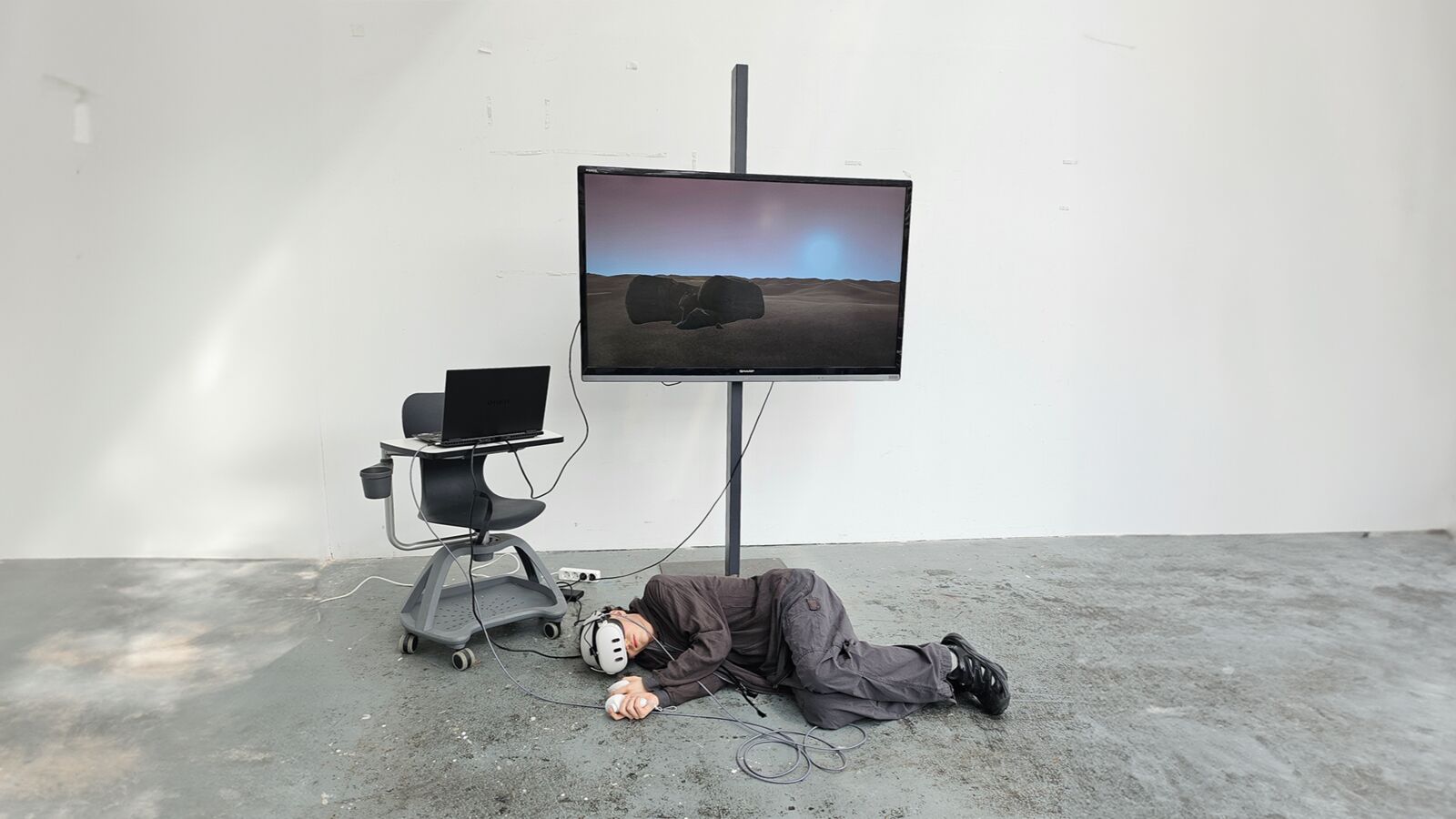
Guus Vandeweerd What if I Was a Stone project, 2024.